• Donate Blood (Opens in a new tab/window)
  • About NBA
  • News and updates
  • Resources
  • BloodPortal login (Opens in a new tab/window)
Logo image Logo image
  • Blood Products
    • Blood Products
    • National Product Price List
    • Fresh Blood Products
    • Albumin Products
    • Clotting Factor and Other Products
    • Immunoglobulin Products
      • Immunoglobulin Usage and Data
      • Intravenous Immunoglobulin (IVIg)
      • Subcutaneous Immunoglobulin (SCIg)
      • Normal Human Immunoglobulin (NHIg)
      • Hyperimmune Immunoglobulin Products
    • Access and Ordering
      • BloodSTAR for Ig Products
      • BloodSTAR Registration Form
      • BloodNet for Blood Products from Lifeblood
      • BloodNet System Interface
      • Frequently Asked Questions
    • Blood Product Management
      • Inventory Management
      • Blood Product Wastage
      • Blood and Inventory Management Resources
      • Case Studies
      • Single Unit Transfusion Guide
  • Supply System
    • Supply System
    • Managing Blood Supply
      • Risk Management
      • National Stewardship Program
      • Blood Product Labelling
    • Governance for Immunoglobulin Products
      • National Immunoglobulin Governance Committees
      • Criteria for Immunoglobulin Products
    • Suppliers and Commercial Supply Contracts
      • Fresh Blood Product Supply and Lifeblood
      • Plasma and Recombinant Product Supply
      • Imported Product Supply
      • Red Cell Diagnostic Product Supply
    • Australian Health Provider Access to Blood and Blood Products
    • Overseas Supply of Blood Products
  • Clinical Guidance
    • Clinical Guidance
      • Rh D Ig Guideline (Opens in a new tab/window)
      • PBM Guidelines (Opens in a new tab/window)
    • National Standards
    • Immunoglobulin
    • Patient Blood Management
      • Patient Blood Management (PBM) Resources
    • Transfusion-related Adverse Events
    • Bleeding Disorders
      • Australian Bleeding Disorders Registry (ABDR)
    • eLearning Courses
    • Public Consultations
    • Patient Blood Management Guidelines (Opens in a new tab/window)
  • Data and Research
    • Data and Research
    • Data and Reporting
    • Research Funding Program
      • Successful Grant Rounds
  • Patient Information
    • Patient information
    • Bleeding disorders
    • Blood disorders
    • Travelling with blood products
    • MyABDR app and the ABDR

Search

  • Donate Blood (Opens in a new tab/window)
  • About NBA
  • News and updates
  • Resources
  • BloodPortal login (Opens in a new tab/window)
  • Blood Products
    • Blood Products
    • National Product Price List
    • Fresh Blood Products
    • Albumin Products
    • Clotting Factor and Other Products
    • Immunoglobulin Products
      • Immunoglobulin Usage and Data
      • Intravenous Immunoglobulin (IVIg)
      • Subcutaneous Immunoglobulin (SCIg)
      • Normal Human Immunoglobulin (NHIg)
      • Hyperimmune Immunoglobulin Products
    • Access and Ordering
      • BloodSTAR for Ig Products
      • BloodSTAR Registration Form
      • BloodNet for Blood Products from Lifeblood
      • BloodNet System Interface
      • Frequently Asked Questions
    • Blood Product Management
      • Inventory Management
      • Blood Product Wastage
      • Blood and Inventory Management Resources
      • Case Studies
      • Single Unit Transfusion Guide
  • Supply System
    • Supply System
    • Managing Blood Supply
      • Risk Management
      • National Stewardship Program
      • Blood Product Labelling
    • Governance for Immunoglobulin Products
      • National Immunoglobulin Governance Committees
      • Criteria for Immunoglobulin Products
    • Suppliers and Commercial Supply Contracts
      • Fresh Blood Product Supply and Lifeblood
      • Plasma and Recombinant Product Supply
      • Imported Product Supply
      • Red Cell Diagnostic Product Supply
    • Australian Health Provider Access to Blood and Blood Products
    • Overseas Supply of Blood Products
  • Clinical Guidance
    • Clinical Guidance
      • Rh D Ig Guideline
      • PBM Guidelines
    • National Standards
    • Immunoglobulin
    • Patient Blood Management
      • Patient Blood Management (PBM) Resources
    • Transfusion-related Adverse Events
    • Bleeding Disorders
      • Australian Bleeding Disorders Registry (ABDR)
    • eLearning Courses
    • Public Consultations
    • Patient Blood Management Guidelines
  • Data and Research
    • Data and Research
    • Data and Reporting
    • Research Funding Program
      • Successful Grant Rounds
  • Patient Information
    • Patient information
    • Bleeding disorders
    • Blood disorders
    • Travelling with blood products
    • MyABDR app and the ABDR

Blood and Inventory Management Resources

  • Home
  • Blood product management
  • Blood and Inventory Management Resources

We have developed tools and resources to improve and support blood management.

Inventory management guidelines

To help AHPs manage blood product inventory more effectively, we developed the Managing Blood and Blood Product Inventory Guidelines for Australian Health Providers.

These guidelines have support or endorsements from the:

  • Australian and New Zealand Society of Blood Transfusion (ANZSBT)
  • Royal College of Pathologists of Australasia (RCPA)
  • National Association of Testing Authorities, Australia (NATA).

The guidelines are available here:

  • Managing Blood and Blood Product Inventory
    15.39 MB
  • Managing Blood and Blood Product Inventory
    8.99 MB
  • Module 1: Managing Blood and Blood Product Transfers
    15.39 MB
  • Module 1: Managing Blood and Blood Product Transfers
    4.28 MB
  • Module 2: Managing Immunoglobulin Inventory
    1.18 MB
  • Module 2: Managing Immunoglobulin Inventory
    1.85 MB

10 Tips to help manage your blood product inventory

We have also created 10 blood and blood product inventory management tips.

  1. Understand your inventory
  2. Provide expert training
  3. Set appropriate inventory levels
  4. Keep procedures simple
  5. Build collaborative relationships
  6. Use oldest product first
  7. Optimise crossmatching procedures
  8. Maintain all equipment appropriately
  9. Have a plan to conserve inventory in times of shortage
  10. Have a patient blood management program

Understanding and implementing these tips will help with more effective inventory management.

  • 10 tips to help manage your blood product inventory
    161.04 KB

Cytomegalovirus (CMV) Seronegative Blood Products

With the help of an expert working group, the NBA developed a Position Paper on the Clinical Use of Cytomegalovirus Seronegative Blood Products in Australia. The Patient Blood Management Guidelines advise that only laboratories that provide blood products to paediatric or pregnancy and birth services should hold CMV seronegative inventory. 

CMV is a common viral infection that is easily acquired in the community setting and is usually mild and self-limiting, although it can potentially have serious consequences for pregnant women, babies and some immunosuppressed patient groups. CMV can also be transmitted through a blood transfusion.

All Australian cellular blood products (except granulocytes) are leucodepleted (removal of white cells).

  • Clinical Use of cytomegalovirus seronegative Blood Products in Australia
    567.77 KB
  • Clinical Use of cytomegalovirus seronegative Blood Products in Australia
    1.68 MB

National Statement on the Clinical Indications for Apheresis and Whole Blood Pooled Platelets

With the help of an expert working group, the NBA developed a National Statement on the Clinical Indications for Apheresis and Whole Blood Pooled Platelets.

This statement aims help clinicians choose the most appropriate platelet infusion and plan for the future demand trends for platelets. 

Clinical indications were reviewed for each type of platelet component based on current evidence and expert opinion considering relevant Patient Blood Management guidelines. 

These clinical indications were used in the development of the National Blood Supply Contingency Plan(Opens in a new tab/window) Annex C- Platelet Response Plan.

  • National Statement on the Clinical Indications for Apheresis and Whole Blood Pooled Platelets
    495.69 KB
  • National Statement on the Clinical Indications for Apheresis and Whole Blood Pooled Platelets
    306.52 KB

Case Studies

To help AHPs meet the National Safety and Quality Health Service Blood Management Standard the NBA have developed a range of Better Practice Case Studies. These Case Studies identify different blood management practices already in existence across the country. Other AHPs can adopt and change the relevant approaches to suit their own conditions.

These case studies show one example of an approach that worked for the AHP. You should consider all effects and risks in your hospital or laboratory before implementing. 

Better Practice Case Studies

Single Unit Transfusion 

We have developed a guide and resources for implementing single unit transfusion based on the Patient Blood Management Guidelines. 

The National Safety and Quality Health Service Blood Management Standard requires blood and blood product policies and procedures to be consistent with national evidence based guidelines. The single unit transfusion guide and resources describes reasons why single unit transfusion is beneficial to patients and includes resources to help you implement it.

Please feel free to adapt, alter and re-badge the single unit transfusion guide and resource material as needed to suit your local area.

Single Unit Transfusion

Audits

To help AHPs meet the National Safety and Quality Health Service Blood Management Standard the NBA have developed two audit tools.

The Massive Transfusion Protocol Clinical Audit Tool can help you to in identify gaps, measure activity and provide evidence to improving practice related to Massive Haemorrhage Protocols. The Audit Tool has two parts:

  • The Audit Tool
    131.49 KB
  • The Audit Tool Database
    93.29 KB

The Red Blood Cell Clinical Audit Tool can help you to measure current practice and improve patient outcomes. The collected data can be used to support the audit and monitoring requirements for the organisation. The Audit Tool has two parts: 

  • The RBC Audit Tool
    124.78 KB
  • The RBC Audit Tool Database
    94.22 KB

Posters and other resources

You can also download digital versions of our posters, guidelines and other inventory management resources.
  • General Group O RhD negative red blood cell management poster
    317.83 KB
  • Blood management poster - landscape
    992.26 KB
  • Blood management poster - portrait
    981.66 KB
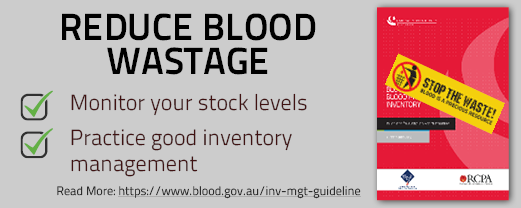
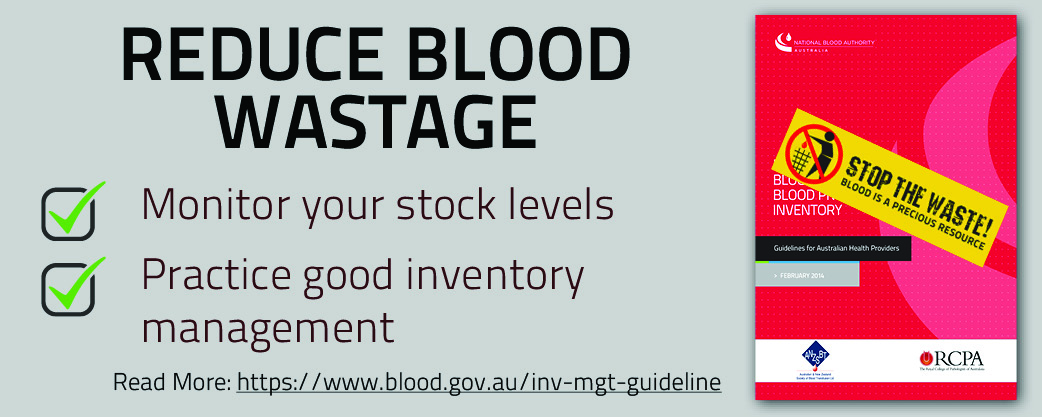
Reduce Blood Wastage Poster

Download your preferred size and format:

png 150 dpi

png 300 dpi

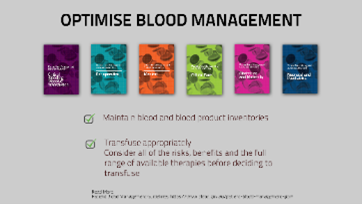
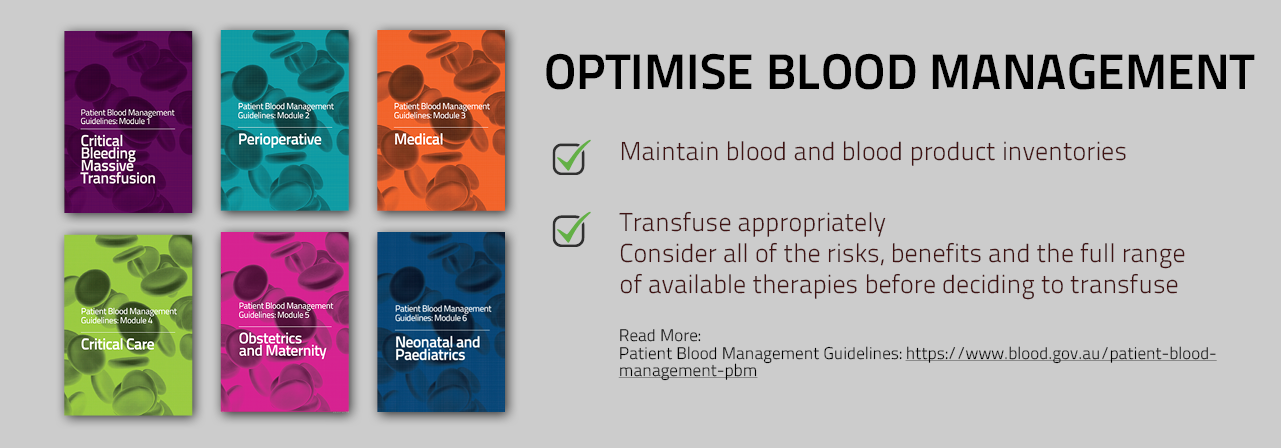
Optimise blood management

Download your preferred size and format:

png 150 dpi

png 300 dpi

Donate Blood image

Download your preferred size and format:

png 150 dpi

png 300 dpi

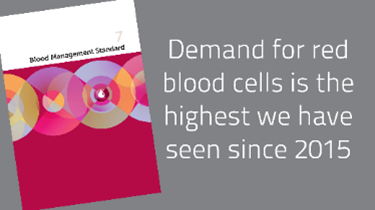
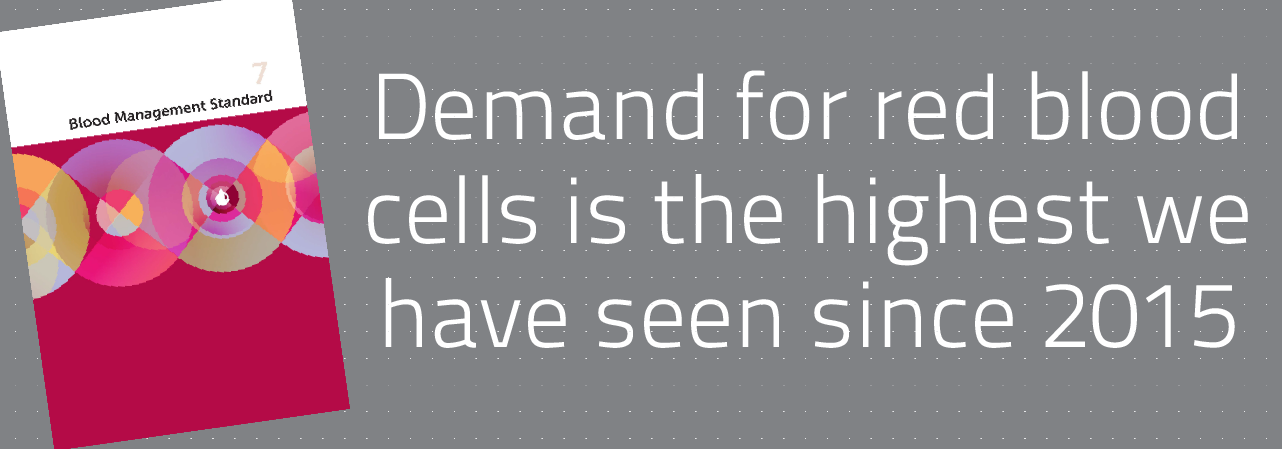
Demand for red blood cells

Download your preferred size and format:

png 150 dpi

png 300 dpi

Blood is a vital source

Download your preferred size and format:

png 150 dpi

png 300 dpi

Promotional campaign

We have developed a targeted range of wastage-reduction promotional material for clinical staff, including:

  • laboratory staff
  • transfusion nurses
  • clinical champions.

We have designed these materials to move discussions of blood product management from laboratories to clinical areas, such as wards or operating theatres.

To order materials, complete the Stop the Waste Promotional order form email support@blood.gov.au.

Last updated: 24 Sep 2024

Back to top

The National Blood Authority acknowledges the Traditional Owners and Custodians of Country throughout Australia, and their continuing connection to land, water and community. We pay our respects to the people, the cultures and the elders past, present and emerging.

National Blood Authority

  • About the NBA
  • Work with us
  • Contact Us
  • Data and reporting
  • Freedom of information
  • Public interest disclosure
  • Resources
  • Accessibility
  • Privacy
  • Copyright
  • Disclaimer
  • BloodPortal Terms and Conditions of Use

Information

  • Blood Products
  • Managing blood supply
  • Supply systems
  • Clinical guidance
  • Patient information
  • Data and research
  • Website feedback